
Engineered Hardwood Installation Methods for Slab Homes
An engineered board can be stuck to the concrete, floated over it or clicked together on top of it, and each method changes the prep, the price and the sound underfoot. The fourth choice, a wide plank with a thick top layer, is made at the showroom.
Glue-down engineered on concrete
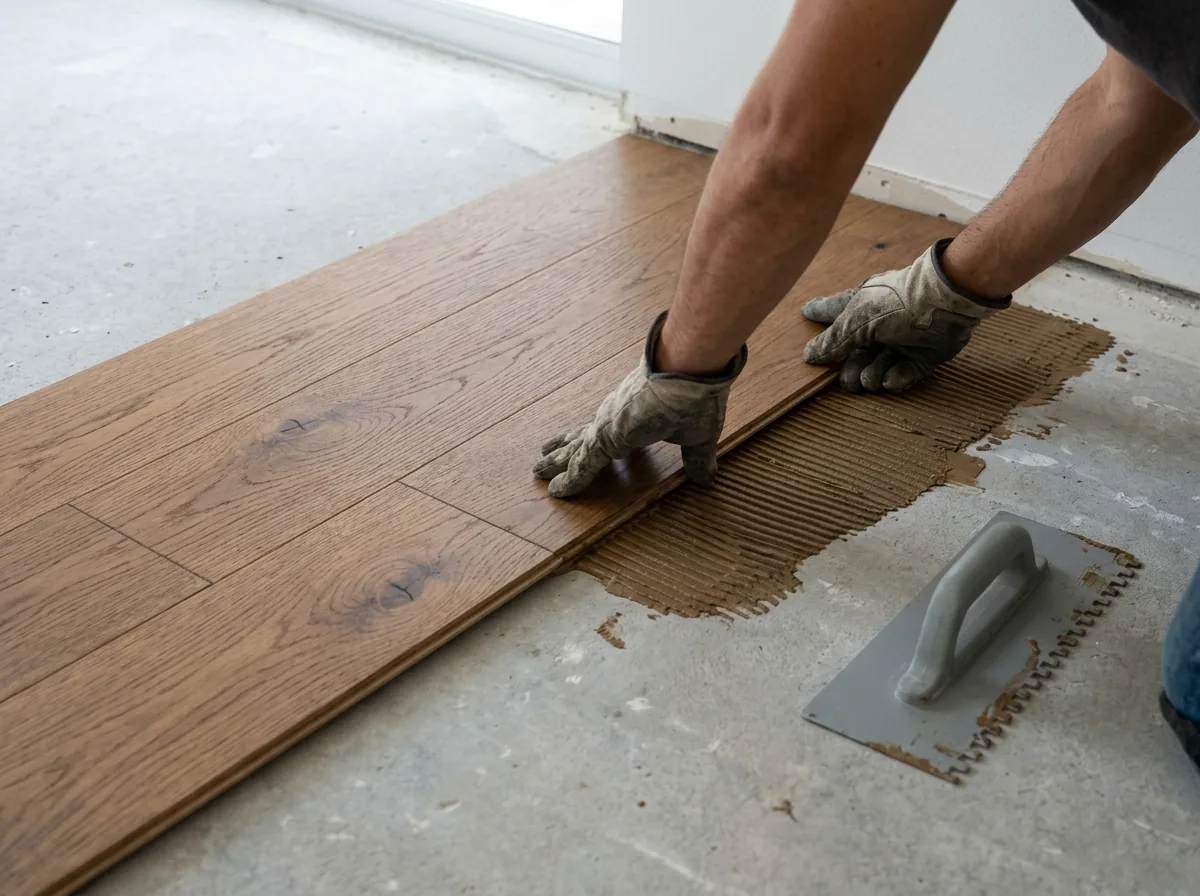
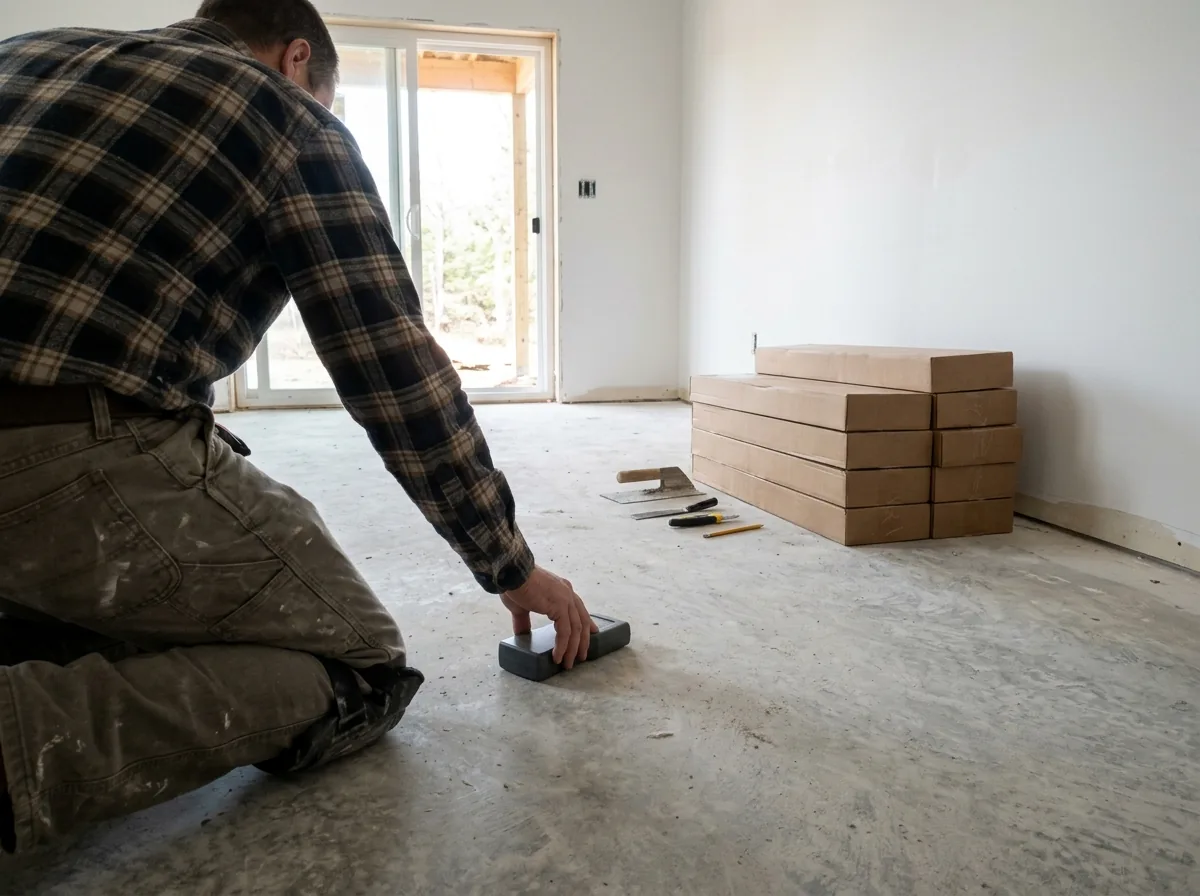
Adhesive goes across the slab with a notched trowel and the planks are set into it, so nothing flexes or clicks underfoot later. That bond only holds on a flat, dry surface. Provenza's instructions spell out how flat, and what happens when the concrete is too damp: a moisture retardant approved as a concrete sealant for wood flooring goes down before the boards.
- Flatness (Provenza): within 1/8 inch over 6 feet, or 3/16 inch over 10 feet.
- Labor alone (HomeGuide engineered guide): $3 to $8 or more a square foot.
- Before gluing: a passing slab moisture test.
Floating engineered over underlayment
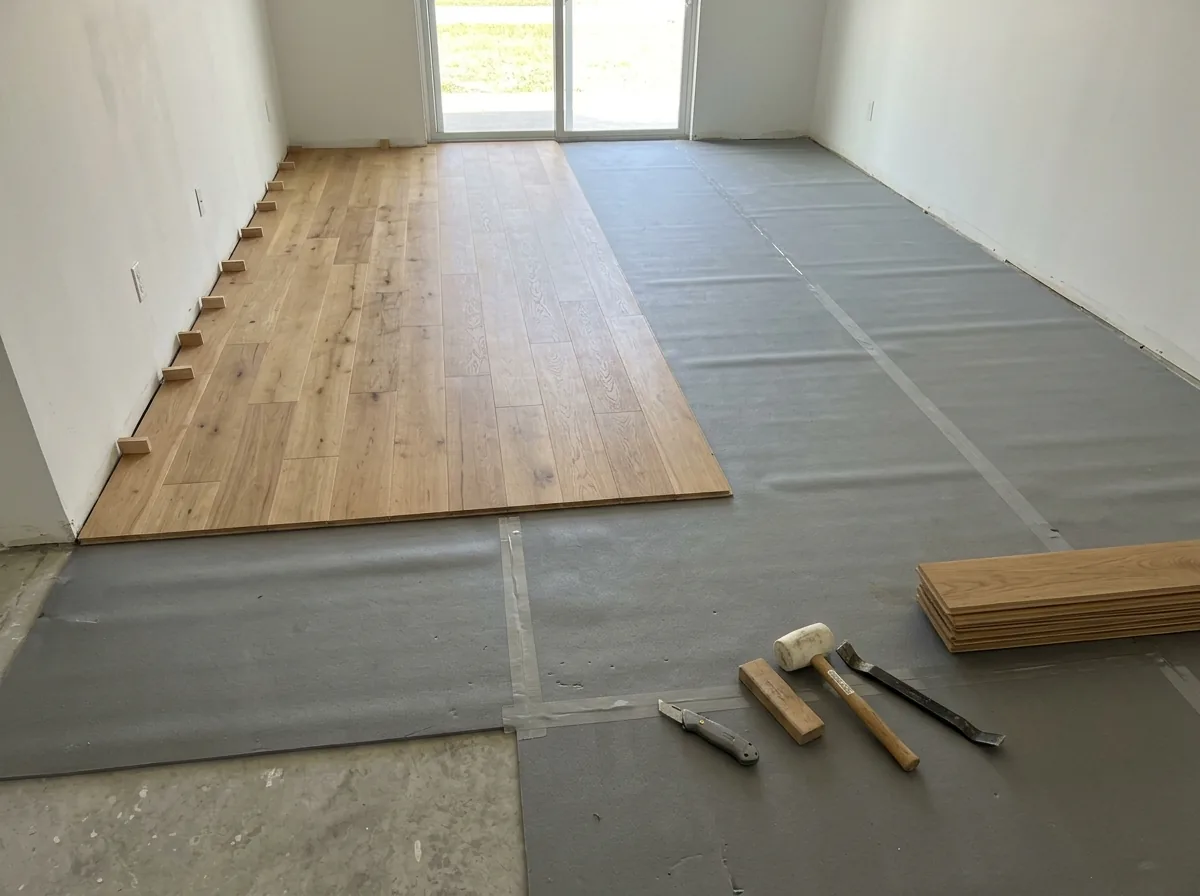
A floating floor joins plank to plank and rests on a sheet underlayment without being fixed to the slab. HomeGuide says the underlayment adds moisture protection, sound dampening and some cushioning over small dips, and also says a floating floor is less durable and needs a level subfloor. Because the floor moves as one piece, a gap is left at every wall and hidden by the trim. Upstairs in a condo, the underlayment also has to pass the city's sound test (condo rules).
- Underlayment (HomeGuide): $0.50 to $1.00 a square foot on top of the boards.
- Wall gap: a good installer leaves the space the maker specifies; on one locking floor (Pergo) that's 3/8 inch on all sides.
Click-lock engineered planks
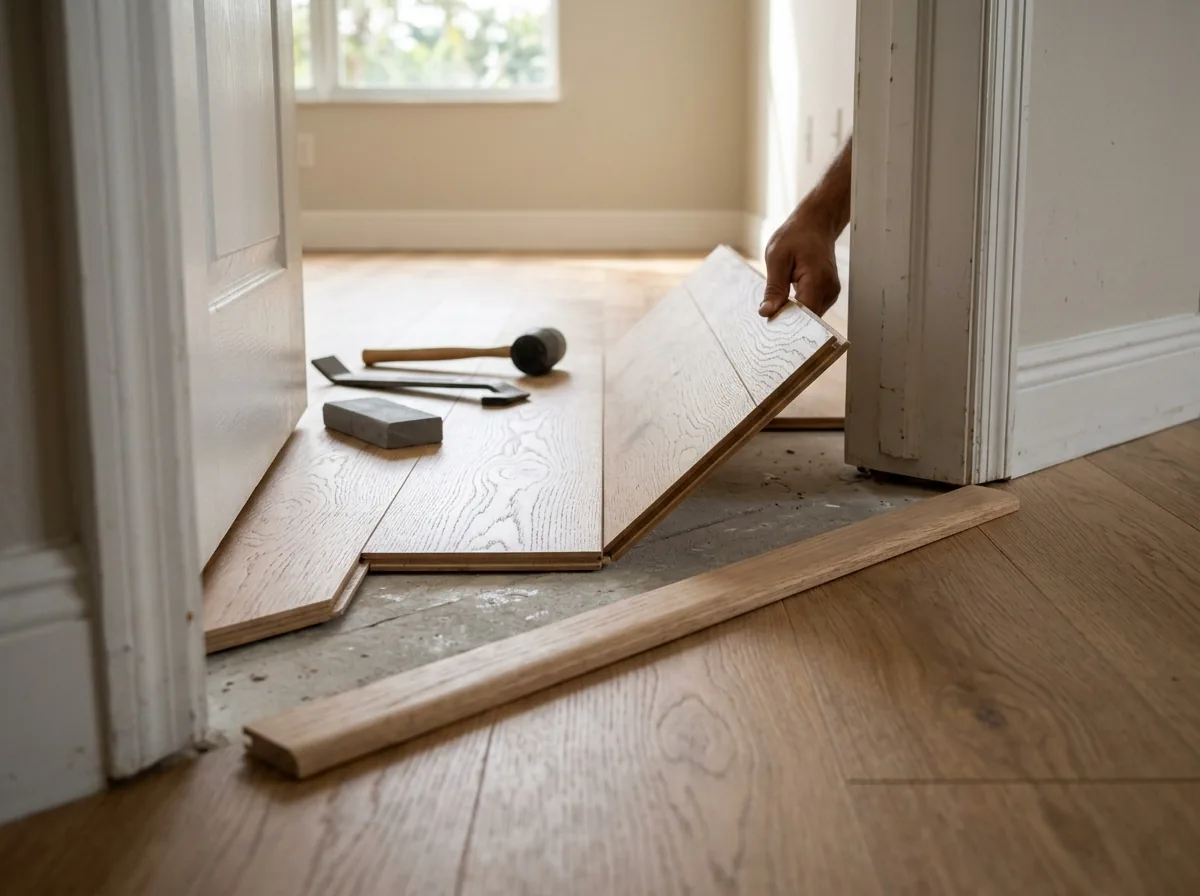
Locking edges snap together without glue, which is why HomeGuide counts click-lock among the cheaper installs to pay for. The catch is in the maker's rules. Pergo's instructions for its locking engineered floor are a fair example of what a click system asks for:
- T-moldings: in every doorway 4 feet wide or less, and in any room 40 feet or more in length or width.
- Free to move: no glue, nails, screws or fixed objects holding the floor down.
- On concrete: a vapor barrier under the planks with seams overlapped 8 inches or more.
- Flatness: no more than 3/16 inch of unevenness in 10 feet.
Ask whether those T-moldings are on the quote; a long open-plan room can get a break where you didn't expect one.
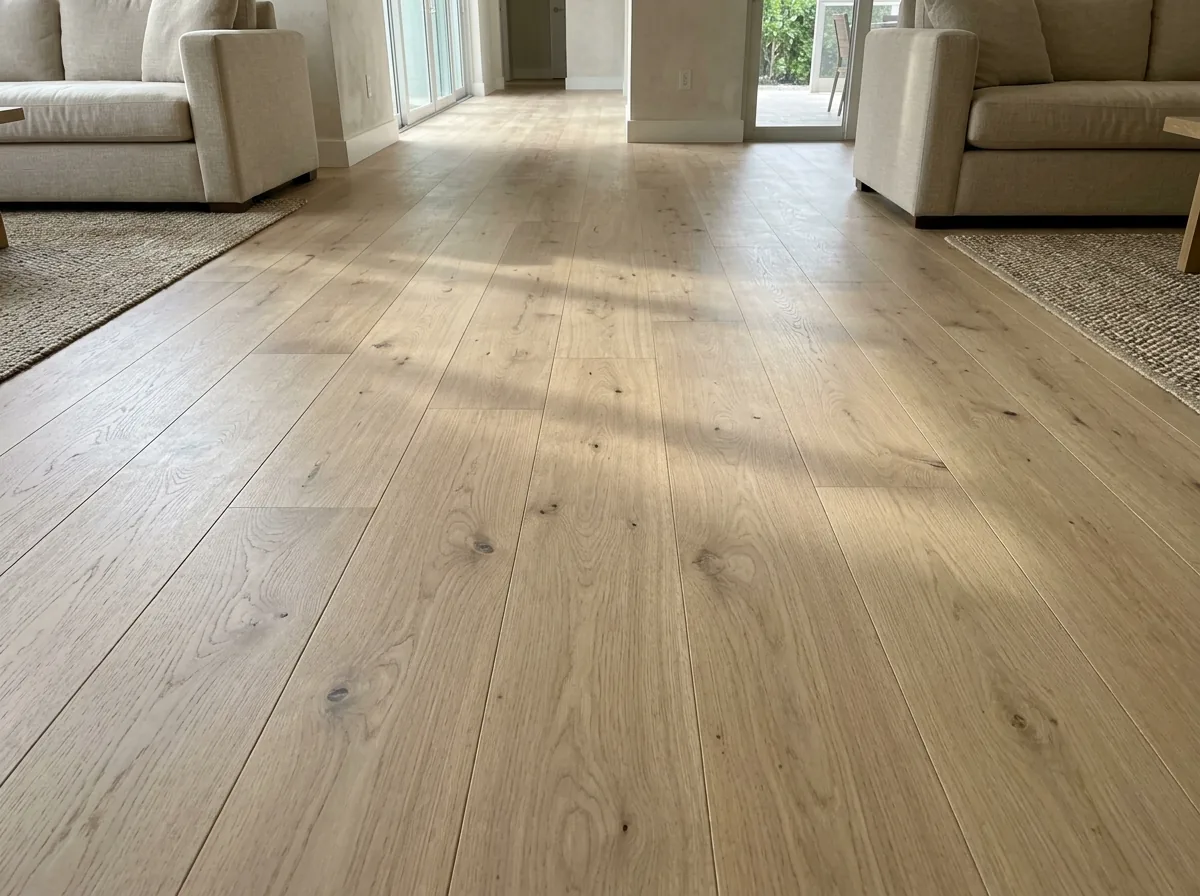
Wide-plank and thick-wear-layer engineered
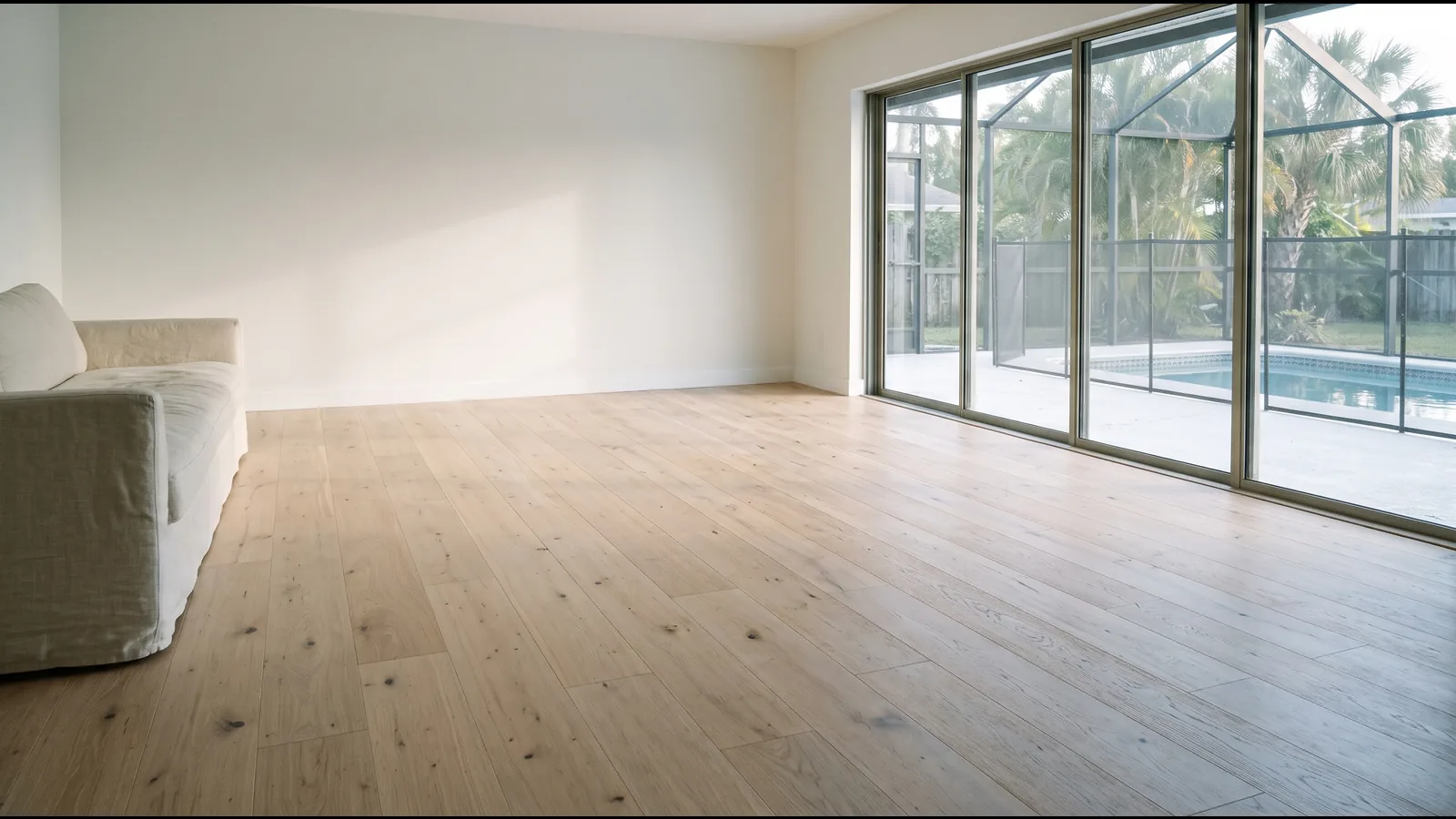
The sawn face on top is the only part that can ever be sanded, so its thickness sets the floor's working life. HomeGuide lists veneers of 2 to 6 mm. Writing in the NWFA's magazine, Brett Miller puts engineered wear layers between 1/16 and 1/4 inch and says sanding isn't recommended below 3/32 inch. Width is the other choice. In solid oak an 8-inch plank shrinks twice as much as a 4-inch one, the same magazine notes, and engineered boards are more stable than solid. That's the case for buying a wide plank as engineered.
- Wear layer to ask for: 3/32 inch (about 2.4 mm) as the floor for any future sanding; 4 to 6 mm if you want several.
Why Pompano Beach homeowners call Pompano Wood Flooring
- One local flooring contractor calls back, not a bidding list
- Asking costs nothing and commits you to nothing
- Ask for the slab moisture readings in writing
- Florida doesn't license flooring: ask for the business tax receipt and insurance certificates
Engineered Hardwood Prices: What Moves the Quote
The guides don't agree on engineered pricing, so a quote is worth checking against more than one of them.
Core build (HomeGuide)
a budget 3-core, 3/8-inch board runs $5 to $17 a square foot installed; a mid-range 5-core, 1/2-inch board $9 to $20.Other guides
Fixr puts engineered at $8 to $14 installed; This Old House lists $6 to $23 a square foot without saying whether labor is included.Boards alone (HomeAdvisor)
$4.50 to $16 a square foot for engineered.What's on the slab now
tile, glue or an old floor has to come off first, and a dished slab gets self-leveler. Those are separate lines (tile removal, floor leveling).
Engineered Hardwood and South Florida Humidity
Wood takes on and gives off water with the air around it, and this is the stretch of the country where the air carries the most.
The NWFA's range
its installation guidelines, quoted in the association's magazine, treat 30% to 50% relative humidity as normal and want boards acclimated to the conditions the room will actually live in.The makers' range
Provenza and Pergo both write 35% to 55% into their instructions as a condition that lasts the life of the floor.Acclimation time
Wagner says most makers ask for at least 3 days with no upper limit; Pergo's locking floor asks for 48 hours, Provenza's for 5 days.The outdoor side
the National Weather Service dates the southeast Florida summer from about May 21 to October 17, with summer dew points staying in the lower to middle 70s.Air conditioning first
Pergo wants the HVAC running 14 days or more before anyone tests the slab or lays a board.
A seasonal house shut up with the AC off from May to October drifts outside every one of those ranges. Ask the installer what humidity setting to leave behind.
Engineered Hardwood Paperwork: License, Labels and Payment
No state flooring license
Florida Statutes 489.117(4)(a)1 lists flooring among the jobs a city or county may not require a license for. Pompano Beach stopped recognizing Broward County's flooring license for permits in August 2025.What the city takes instead
A city Business Tax Receipt number on any permit application, plus proof of general liability and workers' compensation insurance or an approved exemption. Ask to see both.Formaldehyde labels
Since March 22, 2019, hardwood plywood, MDF and particleboard sold in the US must be labeled TSCA Title VI compliant, and the hardwood plywood limit is 0.05 ppm. Rules for laminated products, a veneer on one of those cores, took effect March 22, 2024. Whether an engineered plank is covered depends on its core and resin.Payment terms
Get the payment schedule and deposit in writing, each payment tied to a finished stage.